
Onigiri and omusubi are two names for one of Japan’s most familiar foods: rice shaped into a convenient, handheld meal. If you’ve seen both words on Japanese menus, in convenience stores, or in recipes, you might wonder whether they describe different dishes.
The answer is simple: onigiri and omusubi generally mean the same thing. Neither name requires a particular shape, filling, or preparation method.
But the words have different linguistic roots, and their history offers an interesting look at Japanese food culture. From traditional beliefs about mountains to modern convenience-store packaging, here’s what makes these two names worth exploring.
Are Onigiri and Omusubi the Same?
Yes. In modern Japanese, onigiri (おにぎり) and omusubi (おむすび) are generally interchangeable terms for Japanese rice balls.
Both describe cooked rice formed into a compact shape, often seasoned with salt, filled with ingredients such as salmon or pickled plum, and sometimes wrapped in nori (dried seaweed).
The traditional expression nigiri meshi (握り飯), meaning hand-formed rice, also refers to essentially the same food.
The Japan Onigiri Association explains that the Japanese dictionary Kojien treats these names as equivalent. It also notes that there is no universal distinction based on shape.
You can find the association’s explanation in its guide to the differences between onigiri and omusubi.
| Feature | Onigiri | Omusubi |
|---|---|---|
| Basic meaning | Japanese rice ball | Japanese rice ball |
| Word origin | Associated with nigiru, meaning to grasp or shape by hand | Associated with musubu, meaning to tie or connect |
| Typical shapes | Triangular, round, oval, or cylindrical | Triangular, round, oval, or cylindrical |
| Filling required? | No | No |
| Common usage | Widely used throughout Japan | Also used throughout Japan, including in household expressions and product names |
| Strict culinary distinction? | No | No |
Some people personally associate omusubi with homemade rice balls or triangular shapes. Others simply use whichever word is familiar in their family or region.
These associations are part of everyday language, not official rules.
What Do the Names Onigiri and Omusubi Mean?
The most interesting difference between the two names is linguistic rather than culinary.
Onigiri Comes from “Nigiru”
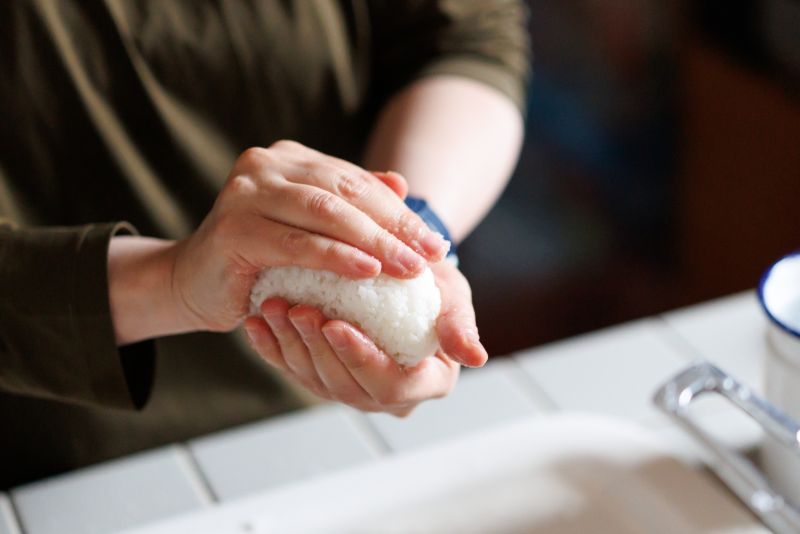
The word onigiri is connected to the Japanese verb nigiru (握る), which means to grasp, hold firmly, or squeeze.
In the context of food, it describes using your hands to press cooked rice together until it holds its shape.
An older expression, nigiri meshi, combines this idea with meshi, a Japanese word for cooked rice or a meal.
Over time, onigiri became one of the standard everyday names for the dish.
The name emphasizes the physical action of making the rice ball. A few handfuls of rice become something compact enough to carry, pack into a lunchbox, or eat without utensils.
That practicality helps explain why onigiri has remained a familiar part of Japanese meals for generations.
Omusubi Comes from “Musubu”
Omusubi is associated with musubu (結ぶ), a Japanese verb meaning to tie, bind, or connect.
The word can describe tying a knot, but it also appears in expressions about forming relationships and creating connections between people.
That broader meaning gives omusubi a slightly different emotional association for some Japanese speakers.
A rice ball made for a family member, packed into a child’s lunch, or shared with someone can naturally evoke the idea of connection.
However, this does not mean that omusubi is automatically more polite, traditional, or affectionate than onigiri. Both are ordinary words in contemporary Japanese.
The Cultural Connection to “Musuhi”
There is also a traditional interpretation connecting omusubi with musuhi (産霊), an ancient Japanese concept associated with creative or life-generating spiritual power.
This concept appears in discussions of early Japanese mythology and Shinto traditions.
Names such as Takamimusubi, a deity mentioned in ancient Japanese texts, contain a related element.
According to one cultural interpretation, forming rice into a compact shape symbolically brings together the life-giving qualities associated with rice, nature, and human effort.
It’s an evocative explanation, especially because rice has played such an important role in Japanese agriculture, religion, and daily life.
However, the direct etymological connection between omusubi and the divine concept of musuhi has not been conclusively established. It is best understood as a traditional cultural interpretation rather than a proven origin of the food’s name.
Does Omusubi Have to Be Triangular?
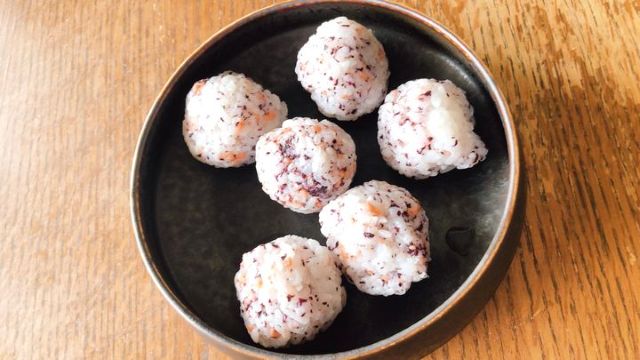
No. Although triangular rice balls are particularly familiar today, omusubi does not have to be triangular.
One popular explanation says that omusubi represents a mountain, while onigiri can take any shape. This distinction has a cultural story behind it, but it is not a consistent rule in Japanese usage.
Why People Associate Rice Balls with Mountains
Mountains have long held religious significance in Japan. In some Shinto traditions, mountains are revered as sacred places associated with deities or spiritual presence.
One theory suggests that triangular rice balls were shaped to resemble mountains as a gesture of gratitude or reverence.
Within this interpretation, the rice ball becomes more than portable food. Its shape symbolizes a connection between people, nature, and the sacred.
It’s a meaningful story, but historical evidence does not establish that all triangular rice balls originated as religious offerings.
There are practical reasons for triangular shapes, too. They are recognizable, relatively easy to arrange, and convenient for modern packaging.
In fact, the triangle has become so strongly associated with convenience-store onigiri that many international visitors immediately recognize the shape as Japanese.
Triangles, Tawara, and Round Rice Balls
Japanese rice balls have traditionally appeared in several different shapes, and regional food customs have influenced their appearance.
| Shape | Japanese Name | Cultural or Practical Association |
|---|---|---|
| Triangle | Sankaku | The widely recognized modern shape; sometimes associated with sacred mountains |
| Short cylinder | Tawara | Resembles a traditional rice bale; historically associated with Kyoto and Osaka food traditions |
| Round | Maru | A familiar homemade shape that can be formed without sharply defined corners |
| Flattened or oval | Varies by region | Useful for different serving styles and regional preparations |
The tawara shape is especially interesting. Tawara means a bale used for storing or transporting agricultural goods, particularly rice.
This short, cylindrical shape was historically common in the Kyoto and Osaka areas, where compact portions of rice were also useful in packed meals.
Traditional bento arrangements, including makunouchi bento associated with theatergoing and other outings, helped preserve the popularity of neatly arranged rice portions.
Historical descriptions also indicate that round and triangular rice balls were common around Edo, now Tokyo.
These differences show how local customs, food presentation, and practical needs influenced rice-ball shapes.
They do not establish a rule that cylindrical rice balls must be called onigiri or that triangles must be called omusubi.
Do Different Parts of Japan Use Different Names?
Regional variation is another reason both names continue to exist.
You may encounter the explanation that people in eastern Japan say onigiri, while people in western Japan prefer omusubi. Other sources describe the opposite pattern.
Neither version accurately captures the full picture.
Historical research cited by the Japan Onigiri Association describes a more complicated regional distribution, including differences among the Kanto, Kansai, Chubu, Chugoku, and Kyushu regions.
Local traditions can also distinguish the names in ways that do not apply elsewhere. For example, some communities have historically associated different rice-ball shapes with different names.
Today, however, onigiri is widely understood throughout Japan, and omusubi remains familiar nationwide.
Convenience stores, supermarkets, television, and food media have helped make both terms recognizable beyond their older regional associations.
For travelers, the practical lesson is straightforward: you can use either onigiri or omusubi almost anywhere in Japan without causing confusion.
A particular store or family may prefer one word, but you are still talking about the same basic food.
How Convenience Stores Use the Names Today
One of the easiest places to see both words in everyday use is the Japanese convenience store, known locally as a konbini.
Major chains such as 7-Eleven, Lawson, and FamilyMart sell rice balls as an everyday grab-and-go meal.
Interestingly, the names on their shelves do not follow a single industry-wide rule.
FamilyMart prominently uses omusubi in its rice-ball product category and promotional campaigns. Its official listings include familiar varieties such as salmon, seasoned rice, and large filled rice balls.
7-Eleven uses both onigiri and omusubi. Its product catalog includes hand-wrapped onigiri and other rice-ball varieties labeled omusubi.
Lawson frequently uses onigiri in its product descriptions and rice-ball promotions.
These differences demonstrate how the two words can coexist in modern Japanese retail.
Businesses may choose terminology for product categories, familiar naming conventions, packaging styles, or brand presentation.
However, it would be misleading to claim that every chain has a permanent rule based on shape, quality, or a particular emotional message.
Product names and marketing campaigns also change over time.
If you’re shopping in Japan, focus on the filling, rice variety, and packaging description rather than trying to identify a culinary difference from the words onigiri and omusubi.
How Rice Balls Became a Japanese Everyday Food
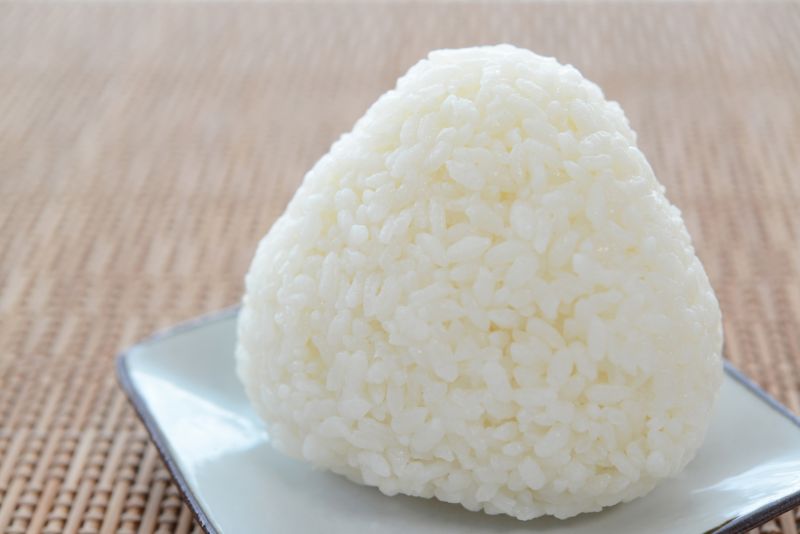
The history of Japanese rice balls stretches back long before convenience stores or modern Japanese cookbooks.
At the Sugitani Chanobatake archaeological site in what is now Nakanoto, Ishikawa Prefecture, researchers discovered carbonized rice remains dating to the Yayoi period, roughly 2,000 years ago.
These remains are sometimes described as Japan’s oldest onigiri.
However, researchers have also interpreted the preserved rice as something closer to a leaf-wrapped, steamed rice preparation, similar in some respects to chimaki.
It is therefore more accurate to regard the discovery as evidence of ancient shaped-rice food traditions than as proof of an identical modern onigiri recipe.
Rice portions resembling later onigiri also appear in historical Japanese writing.
During the Heian period (794–1185), a food called tonjiki was distributed in certain courtly and ceremonial settings.
These portions of shaped rice are often discussed as predecessors of modern rice balls.
Over subsequent centuries, compact rice portions served an obvious purpose: they were portable and could be eaten without plates or chopsticks.
They were useful to travelers and people working away from home, including soldiers during periods of military conflict.
In the Edo period (1603–1868), rice balls continued to develop alongside regional cooking and packed-meal traditions. Nori became an increasingly familiar accompaniment as seaweed cultivation and distribution expanded.
By the twentieth century, rice balls were firmly established as everyday homemade food.
The growth of convenience stores in the 1970s and subsequent innovations in packaging helped make commercially prepared onigiri especially accessible.
Modern packages often keep the nori separate from the rice until opening, preserving its crisp texture.
Today, Japanese rice balls range from plain salted rice to elaborate versions featuring seafood, meat, vegetables, and seasoned rice.
For a detailed account of their cultural development, see Nippon.com’s history of onigiri.
Two Japanese Rice Ball Days and What They Mean
Japan has two observances that use the different names: Omusubi Day and Onigiri Day.
Their origins are quite different, illustrating how rice balls can represent both human connections and the long history of rice cultivation.
January 17: Omusubi Day
Omusubi Day is observed on January 17, the anniversary of the Great Hanshin-Awaji Earthquake of 1995.
After the disaster, volunteers provided rice balls to people affected by the earthquake.
These simple meals became a symbol of mutual assistance, especially during a time when everyday infrastructure and food supplies had been severely disrupted.
The observance was established to remember the disaster and recognize the importance of helping one another.
The choice of omusubi is particularly meaningful because of the word’s association with musubu, or connecting people.
Here, that symbolism is a documented part of the observance’s purpose rather than merely a theory about ancient word origins.
June 18: Onigiri Day
Onigiri Day is celebrated on June 18 and is associated with the ancient rice remains discovered in Nakanoto, Ishikawa Prefecture.
The observance recognizes the area’s connection to the early history of shaped rice in Japan.
The date has a specific local explanation. June represents the number six, associated with the former town of Rokusei, while the eighteenth was already recognized as a monthly day celebrating rice consumption.
The rice character 米 also contains elements resembling the characters for ten and eight, giving the number eighteen an additional cultural association.
These details are explained by Nakanoto Town’s official Onigiri Day information.
Unlike January 17, which commemorates the response to a specific disaster, June 18 celebrates a local archaeological discovery and Japan’s longstanding rice culture.
How to Recognize and Eat Onigiri Outside Japan
If you’re new to Japanese rice balls, knowing a few ingredients and naming conventions will make shopping or ordering much easier.
Popular Fillings and What the Names Do Not Tell You
Neither onigiri nor omusubi tells you whether a rice ball has a filling.
Both names can describe plain salted rice or rice containing ingredients.
Popular Japanese varieties include:
- Shake (鮭): Cooked salmon, often salted and flaked.
- Umeboshi (梅干し): Pickled Japanese plum, known for its tangy, salty flavor.
- Tsuna mayo (ツナマヨ): Tuna mixed with mayonnaise.
- Kombu (昆布): Kelp, often simmered in a sweet-savory seasoning.
- Okaka (おかか): Bonito flakes commonly seasoned with soy sauce.
- Shio musubi (塩むすび): A simple salted rice ball, usually without a filling.
Shio musubi is a particularly useful example because the name includes musubi even though the rice ball contains no filling.
This directly contradicts the popular claim that omusubi must be stuffed while onigiri must be plain.
If you’re making rice balls at home, Japanese short-grain rice is a practical choice because its texture helps the grains hold together when shaped.
You can also use an onigiri mold if you find shaping the rice by hand difficult. The tool does not change what the food is called.
Japanese Omusubi vs. Hawaiian Spam Musubi
English speakers, particularly in the United States, may already recognize the word musubi from Hawaiian food.
Spam musubi is a popular Hawaii snack consisting of a slice of cooked Spam luncheon meat placed on or alongside a compact block of rice, usually held together with nori.
It developed within Hawaii’s multicultural food traditions, drawing on Japanese rice-ball influences while becoming a distinctive local dish.
The word musubi is related to Japanese omusubi, but the terms are used differently in context.
In Japan, omusubi generally refers to the broad category of shaped rice balls.
In Hawaii, musubi often brings to mind Spam musubi or other local variations, although the term is not limited to Spam.
So if you order omusubi in Japan, don’t assume you’ll receive the rectangular Spam-topped snack familiar in Hawaii.
How to Open Convenience-Store Onigiri
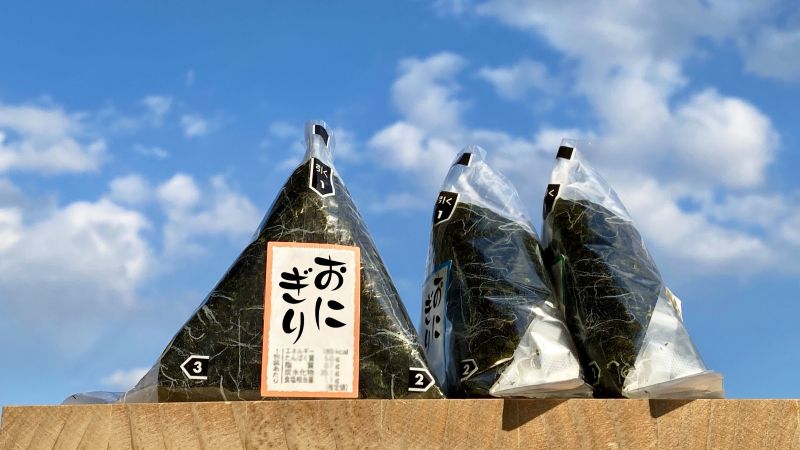
If you buy a triangular rice ball from a Japanese convenience store, you may notice that the plastic wrapping has numbered tabs.
This packaging is designed to keep the nori separated from the moist rice until you’re ready to eat.
On a typical numbered package:
- Find the tab marked “1” and pull it down along the center of the package, following the printed direction.
- Remove the side of the wrapper marked “2” without pulling the seaweed away from the rice.
- Remove the remaining side marked “3” so the nori settles around the rice ball.
The exact design can vary by product, so follow the instructions printed on the packaging.
The Japan Foundation also provides an illustrated explanation of convenience-store onigiri packaging.
Once unwrapped, an onigiri can usually be eaten by hand. Whether the package calls it onigiri or omusubi, the basic eating experience is the same.
Frequently Asked Questions
How do you pronounce onigiri and omusubi?
Onigiri is pronounced approximately “oh-nee-gee-ree,” while omusubi is pronounced “oh-moo-soo-bee.” Both words have four Japanese morae, or rhythmic sound units, rather than the stress patterns typical of many English words.
Is omusubi a more polite word than onigiri?
Not necessarily. Some speakers feel that omusubi sounds softer or more traditional, but both words are acceptable in everyday Japanese. Neither is automatically more respectful or formal.
Is onigiri the same as sushi?
No. Onigiri generally uses cooked rice that has not been seasoned with sushi vinegar. Sushi is defined by its seasoned rice, typically prepared with vinegar, sugar, and salt. Both dishes can contain fish, but that does not make them the same food.
Does onigiri need to be wrapped in seaweed?
No. Nori is common but optional. Plain salted rice balls, rice balls with ingredients mixed throughout, and many regional varieties are served without a seaweed wrapper.
Can you make omusubi with a rice mold instead of your hands?
Yes. A rice mold is useful for making consistent triangles or other shapes, especially for beginners. Although the traditional vocabulary refers to shaping rice by hand, using a mold does not prevent the finished food from being called either onigiri or omusubi.