
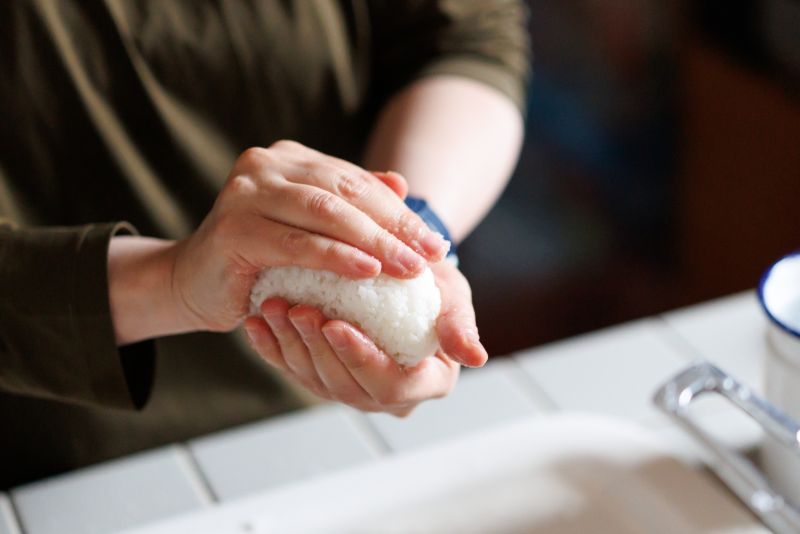
If your homemade onigiri tastes bland, the problem may be as simple as the way you are using salt. In Japan, the traditional method is to wet clean hands, rub a small amount of salt over the palms, and shape warm rice. This is known as te-shio, or salting the hands.
Mixing salt directly into the cooked rice is another useful option, especially when you want consistent seasoning across a large batch or plan to shape your onigiri with plastic wrap. If you choose this method, about 0.8% of the cooked rice weight is a useful starting point. For plain shio onigiri, you can increase it toward 1.0% if you prefer a more noticeable salty flavor.
That means 150 g (5.3 oz) of cooked rice would take roughly 1.2 to 1.5 g of salt. Treat this as a starting range rather than a universal rule. The right amount depends on your salt, your fillings, and your personal taste.
How Much Salt Should You Use for Onigiri?
A Practical Starting Ratio for Mixing Salt Into Rice
When salt is mixed directly into the rice, weighing it is much more reliable than measuring it by the teaspoon. Different salts can have very different crystal sizes, so the same teaspoon can contain noticeably different weights.
For plain onigiri, try this simple formula:
Cooked rice weight × 0.008 = a good starting amount of salt
If you want a distinctly salty shio onigiri, you can experiment up to around 1.0%:
Cooked rice weight × 0.01 = a stronger level of seasoning
There is nothing magical about these percentages. They are simply useful starting points for evenly seasoned rice. If you are using salty fillings such as umeboshi, salted salmon, or kombu simmered in soy sauce, use less salt in the rice.
Salt Amounts for Common Quantities of Cooked Rice
| Cooked Rice | 0.8% Salt | 1.0% Salt | Approximate Use |
|---|---|---|---|
| 100 g / 3.5 oz | 0.8 g | 1.0 g | About 1 medium onigiri |
| 150 g / 5.3 oz | 1.2 g | 1.5 g | 1 large or 1–2 smaller onigiri |
| 330 g / 11.6 oz | 2.6 g | 3.3 g | About 1 Japanese rice-cooker cup of dry rice, once cooked |
| 660 g / 23.3 oz | 5.3 g | 6.6 g | About 2 Japanese rice-cooker cups of dry rice, once cooked |
If you do not own a kitchen scale, start conservatively. You can always add a little more salt, but you cannot remove it once it has been mixed into the rice.
What Does “1 Go” of Japanese Rice Mean?
Japanese recipes often measure uncooked rice in go. One go is the amount held by a standard Japanese rice-cooker cup, which has a capacity of 180 mL. It is smaller than a U.S. measuring cup.
One go of uncooked Japanese rice weighs approximately 150 g and typically produces roughly 330 g (11.6 oz) of cooked rice, although the final weight varies with the rice and the amount of water absorbed.
If you see a Japanese recipe calling for “1 cup of rice,” check whether it means a Japanese rice-cooker cup or a U.S. cup. They are not interchangeable.
Salted Hands vs. Mixing Salt Into the Rice
Both methods can make good onigiri, but they create a different eating experience.
| Method | Main Advantage | Best For |
|---|---|---|
| Salt on wet hands | Creates a saltier surface and a contrast between the outside and plain rice inside | Traditional shio onigiri and onigiri eaten soon after shaping |
| Salt mixed into rice | Seasoning is distributed consistently throughout the rice | Large batches, plastic-wrap shaping, and people who prefer even seasoning |
The Traditional Japanese Method: Te-Shio
The classic Japanese technique is simple. Wet clean hands lightly with water, apply a small pinch of salt to the palms, spread it over the surface of your hands, and then shape the warm rice.
This is often called te-shio. Instead of making every grain equally salty, it concentrates more of the seasoning on the outside of the onigiri. You taste the salt first, followed by the mild sweetness and aroma of the rice.
This method works especially well for plain shio onigiri, where rice and salt are the main flavors.
The goal is not to squeeze the rice tightly. Use just enough pressure to make the grains hold together. An onigiri should keep its shape but still feel light rather than dense and gummy.
When Mixing Salt Into the Rice Makes Sense
Mixing salt into the rice is useful when you want every bite to taste similar. It is also convenient if you are making several onigiri at once or prefer shaping them with plastic wrap instead of bare hands.
This method can be particularly helpful for beginners because the amount of salt is easier to measure and repeat.
It is not necessarily more authentic or less authentic than every other method. Japanese home cooking varies from household to household. The main difference is the result: mixed salt gives you even seasoning, while salted hands give you more contrast between the surface and the center.
How to Mix Salt Into Rice Without Making It Gummy
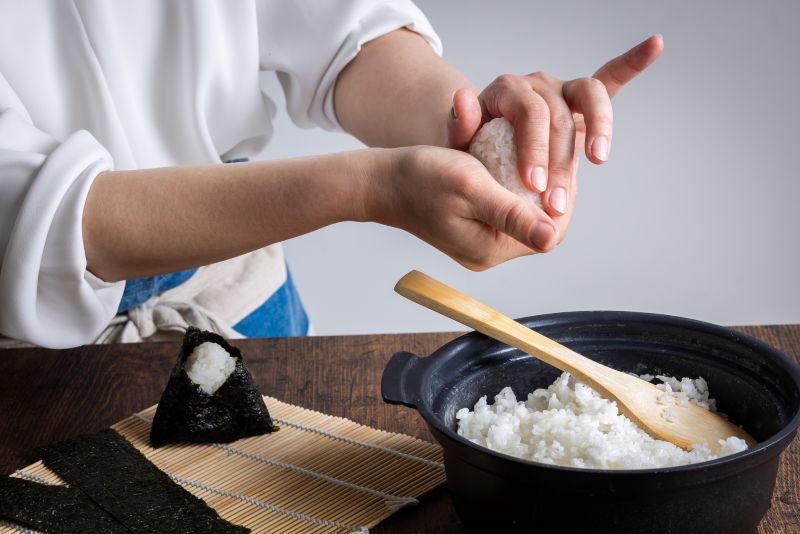
One common mistake is stirring freshly cooked rice too aggressively. Japanese short-grain rice is naturally sticky, and excessive mixing can crush the grains and make the texture heavy.
- Cook Japanese short-grain rice according to the package or rice-cooker instructions.
- When the rice is cooked, gently fluff it with a rice paddle.
- Measure the amount of cooked rice you plan to use.
- Calculate your starting amount of salt based on the cooked rice weight.
- Sprinkle the salt evenly over the warm rice instead of dumping it into one spot.
- Use the edge of a rice paddle to fold and cut through the rice gently until the salt is distributed.
- Shape the rice while it is still warm enough to hold together comfortably.
Avoid kneading or mashing the rice. The individual grains should remain visible after shaping.
How to Adjust the Salt for Different Onigiri Fillings
The salt in the rice is only part of the final seasoning. Traditional onigiri fillings can contribute a substantial amount of salt themselves.
| Filling | Typical Saltiness | How to Season the Rice |
|---|---|---|
| Umeboshi | Often high | Use much less salt in the rice, or try unsalted rice first |
| Salted salmon | Medium to high | Reduce the salt and adjust after tasting the salmon |
| Shio kombu | High | Usually needs very little additional salt |
| Tuna mayo | Medium | Use moderate seasoning and account for mayonnaise or soy sauce |
| Plain shio onigiri | No filling | Use the full amount of seasoning you prefer |
| Edamame or corn | Low unless pre-seasoned | A normal amount of salt usually works well |
Umeboshi and salted salmon vary greatly from product to product, so fixed numbers are less useful than tasting the filling first.
When trying a new filling, make a small test onigiri before seasoning an entire batch. This is especially useful with imported Japanese ingredients, which may have very different sodium levels depending on the brand.
What Kind of Salt Is Best for Onigiri?
You do not need a special Japanese salt to make good onigiri. Fine sea salt, table salt, and kosher salt can all work.
The most important practical difference is crystal size. A teaspoon of fine table salt can contain considerably more salt by weight than a teaspoon of a light, coarse kosher salt. That is why measuring by grams gives you more consistent results.
Fine salt is convenient when mixing seasoning throughout the rice because it disperses easily. Slightly coarser sea salt can be enjoyable with the traditional salted-hand method because small crystals remain on the surface of the rice.
If you want to explore Japanese salts, moshio is an interesting option. It is a traditional Japanese seaweed-infused salt and can add a subtle savory character, particularly to seafood-based onigiri.
Should You Add Salt While Cooking the Rice?
You can find recipes that add salt before the rice is cooked, but it is not necessary for traditional onigiri. The classic approach is to cook plain Japanese short-grain rice and season it during shaping.
Seasoning after cooking also gives you more control. You can keep part of the batch plain, season another part for shio onigiri, and adjust the rest according to the fillings.
If you want to experiment with adding salt to a rice cooker, check the instructions for your particular appliance and follow its recommendations for seasoned rice. There is no need to change your normal water amount simply because you are making onigiri unless your rice recipe or appliance instructions specifically tell you to do so.
Why Does Simple Shio Onigiri Taste So Good?
Shio onigiri, also called shio musubi, is simply rice seasoned with salt. There may be no filling at all, yet a well-made one can be surprisingly satisfying.
Part of the appeal comes from contrast. Japanese short-grain rice has a mild natural sweetness and aroma. A small amount of salt makes those qualities easier to notice instead of covering them with a strongly flavored filling.
The traditional salted-hand method strengthens that contrast even further. The outside tastes noticeably salty when it first touches your tongue, while the center remains comparatively mild.
Texture matters just as much as seasoning. Freshly cooked rice that has been shaped gently retains a soft, slightly airy structure. If it is compressed too firmly, even perfectly seasoned rice can feel dense and less enjoyable.
How to Make Onigiri With Plastic Wrap
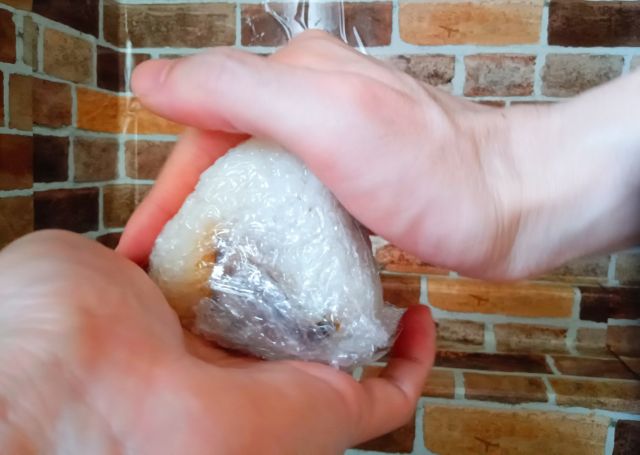
Plastic wrap is a convenient way to shape onigiri without having the rice stick to your hands. It is also a useful option when preparing food for a lunchbox.
- Cook the rice and gently fluff it.
- If using the mixed-in method, add your measured salt while the rice is still warm and fold gently.
- Place a sheet of food-safe plastic wrap over a small bowl or on a clean work surface.
- Add a portion of warm rice to the center.
- Add the filling, if using, and cover it completely with additional rice.
- Gather the plastic wrap around the rice.
- Shape it gently into a triangle, round ball, or cylinder without squeezing excessively.
- Unwrap before serving and add nori when desired.
For this method, mixing the salt into the rice beforehand is usually easier than trying to sprinkle salt randomly over the plastic wrap. It gives you more predictable seasoning from one onigiri to the next.
Food Safety Tips for Onigiri and Lunchboxes
Salt should be treated as seasoning, not as a substitute for safe food handling. This is especially important when onigiri will be packed for lunch rather than eaten immediately.
Cooked rice can support the growth of foodborne bacteria when it is handled or stored improperly. Fillings such as tuna mayo, meat, eggs, and fish add their own storage considerations.
- Wash your hands thoroughly before preparing food.
- If making lunchbox onigiri, consider shaping them with plastic wrap or clean disposable food-preparation gloves rather than directly with bare hands.
- Keep utensils and preparation surfaces clean.
- Do not assume that adding extra salt makes room-temperature storage safe.
- Avoid leaving cooked rice or perishable fillings at room temperature for extended periods.
- Follow local food-safety guidance for cooling, refrigeration, and transporting packed lunches.
Japanese food-safety guidance specifically recommends using plastic wrap or disposable gloves when shaping onigiri for packed lunches to reduce contamination from hands. For food that needs refrigeration, U.S. food-safety guidance generally recommends refrigerating leftovers within two hours, or within one hour when the ambient temperature is above 90°F (32°C).
Frequently Asked Questions
Do you put salt in onigiri rice?
You can, but you do not have to. Traditional Japanese onigiri is commonly made by applying salt to wet hands and shaping plain cooked rice. Mixing salt into the rice is useful when you want more even seasoning or are shaping onigiri with plastic wrap.
How much salt do I need for one onigiri?
If you are mixing salt directly into the rice, about 0.8% of the cooked rice weight is a useful starting point. For a 100 g (3.5 oz) onigiri, that is approximately 0.8 g of salt. Use less when the filling is already salty.
Why does my homemade onigiri taste bland?
You may need slightly more salt, but check the rice too. Use Japanese short-grain rice, season it consistently, and avoid making the onigiri excessively large compared with the amount of filling. Plain shio onigiri also benefits from having enough salt on its surface to contrast with the rice.
Can I use kosher salt for onigiri?
Yes. Kosher salt works, but different brands have different crystal sizes and densities. Measuring by weight rather than by teaspoon makes it easier to reproduce the same seasoning.
Should I add salt if my onigiri has a salty filling?
Usually less than you would use for plain onigiri. Umeboshi, salted salmon, shio kombu, and other strongly seasoned fillings can provide much of the salt you need. Taste the filling first and season the rice accordingly.
Is it better to shape onigiri with your hands or plastic wrap?
Both methods work. Salted wet hands give you the traditional surface seasoning of shio onigiri. Plastic wrap is convenient, keeps rice off your hands, and is particularly useful when preparing onigiri for a packed lunch.