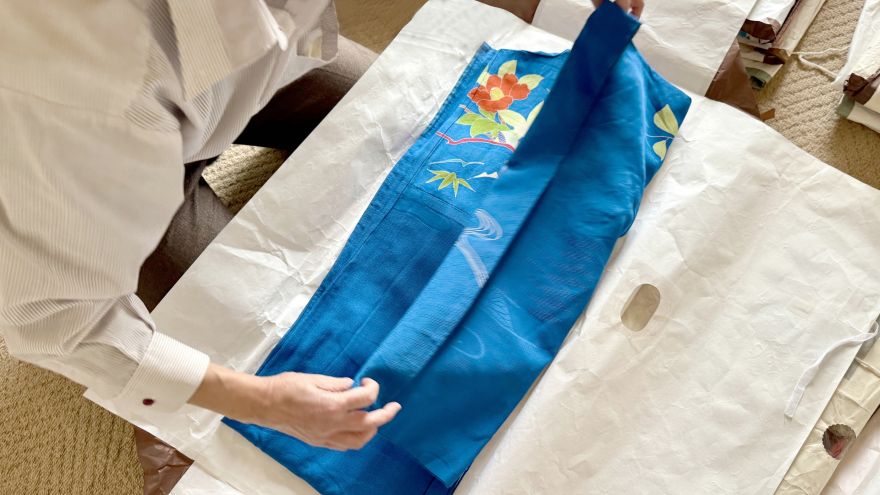
Found a beautiful secondhand kimono but can’t tell whether it’s real silk or polyester? Start with the fabric label or any original paperwork. If those are missing, look at the sheen, feel the drape, inspect the weave, and check the lining. Together, these clues can help you make an informed judgment, but no single touch or visual test can guarantee that a kimono is 100% silk.
This matters for more than the purchase price. Vintage silk, modern washable polyester, and blended fabrics may require very different care. If the material is unknown, don’t put the kimono in the washing machine just to find out.
How to Tell If a Kimono Is Silk or Polyester
Check Japanese fabric labels and original paperwork first
Some modern kimonos have a sewn-in fiber-content label. Older pieces may have no label at all, especially if they were custom-tailored from a tanmono, a bolt of kimono fabric. The original paper certificate, called a shoshi (証紙), may have been kept separately after tailoring.
These Japanese terms are useful when shopping on Japanese resale sites:
| Japanese wording | What it means |
|---|---|
| 正絹 (shoken) | Pure silk; commonly used in kimono descriptions |
| 絹100% | 100% silk |
| ポリエステル | Polyester |
| 化繊 (kasen) | Synthetic fiber; not necessarily polyester |
| 綿 / 毛 | Cotton / wool |
| 麻 (asa) | Bast fiber, such as linen or ramie; ask for the exact fiber |
| レーヨン | Rayon |
Be careful with listings that say only “silky,” “silk feel,” or “kimono silk style.” These descriptions are not the same as an actual fiber-content statement. If the listing says “pure silk” but its label says polyester, ask the seller to clarify before purchasing.
Compare the sheen and drape in natural light
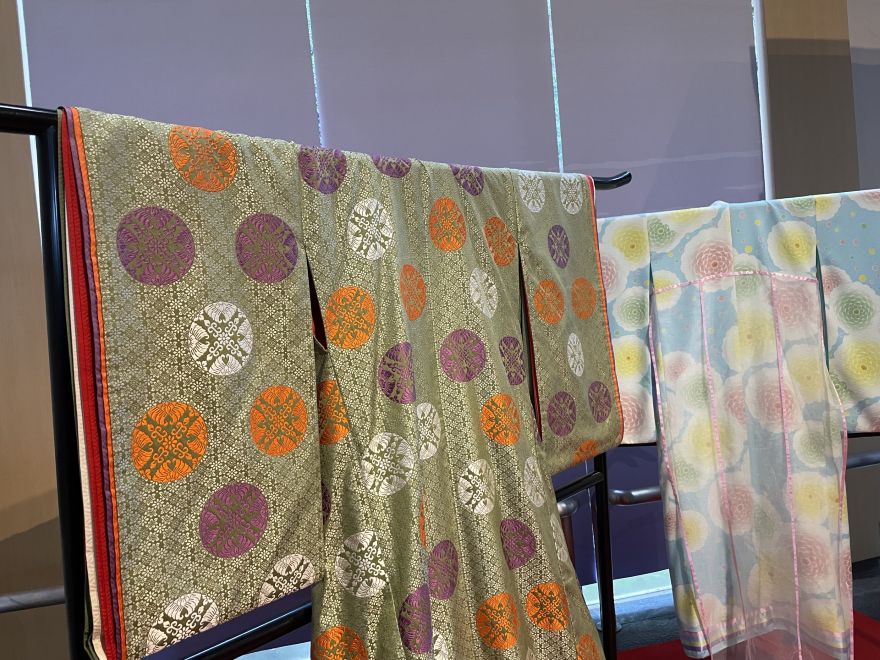
Many silk kimono fabrics have a soft, shifting luster that looks different as you move the cloth under daylight. Some polyester fabrics show a sharper, more uniform reflection. Silk may also fall into supple folds, while a stiffer synthetic weave can hold its shape.
These are tendencies, not rules. Contemporary polyester can imitate silk extremely well, and silk itself ranges from glossy satin-like weaves to comparatively matte, textured tsumugi.
| Feature | Silk: common appearance | Polyester: common appearance |
|---|---|---|
| Sheen | Often soft and varied with the angle of light | May look more even or sharply reflective |
| Drape | Often supple, depending on weave and finish | Ranges from fluid to springy or structured |
| Touch | May feel smooth, dry, crisp, or slightly textured | Can feel equally smooth or silk-like |
| Wrinkles | Some weaves crease relatively easily | Many are wrinkle-resistant, but not all |
To compare safely, place the garment on a clean surface or support it gently and tilt a small section toward a window. Do not pull, rub vigorously, or crease fragile vintage fabric.
Listen for silk scroop, known in Japan as kinunari
When certain silk fabrics move against themselves, they produce a faint squeak or rustle. In Japanese, this is called kinunari (絹鳴り), often translated as “silk scroop.” It can be a useful clue if you already know what the sound is like.
However, finishing treatments, weave, fabric age, and humidity can change the sound. A silent kimono isn’t automatically polyester, and an audible rustle isn’t proof of silk. Treat it as one clue alongside labels and construction details.
Other Kimono Fabrics That Can Be Mistaken for Silk
Chirimen and tsumugi describe fabric styles, not a guaranteed fiber content
Chirimen (縮緬) is a Japanese crepe fabric with a fine, pebbled surface called shibo. Traditional silk chirimen has a distinctive textured drape, but polyester chirimen also exists. A crepe-like surface alone cannot authenticate silk.
Tsumugi (紬) refers to a family of Japanese woven textiles traditionally associated with silk yarns and often with a slightly uneven texture. Some tsumugi feels soft and nubby; other varieties, including Oshima tsumugi, can be remarkably smooth and lightweight. Never assume that roughness means wool or that smoothness means polyester.
Summer kimono fabrics add another complication. Open weaves such as ro and sha can be made in different fibers. Their airy structure tells you about the weave, not necessarily the material.
Recognize wool, cotton, linen, ramie, and rayon
Wool kimonos often have a warmer, fuller hand and were commonly worn as practical everyday garments. Cotton may feel comparatively matte and structured, especially in casual wear and yukata. Linen and ramie can be crisp and breathable, making them familiar choices for warm-weather clothing.
Rayon deserves special attention when buying older garments. It is a regenerated cellulose fiber that may drape beautifully and look similar to silk. A silky appearance does not rule out rayon, and rayon should not automatically be treated as machine-washable.
Fabric texture, weight, weave, and finishing all interact. Think of these observations as ways to narrow the possibilities rather than make a final diagnosis.
How to Inspect a Vintage Kimono Before Buying
Look at the lining, seams, and overall condition
A lined kimono is called an awase (袷). Its upper inner lining is the douura (胴裏); the lower and cuff-facing lining is the hakkake (八掛). Check them separately from the outer fabric. A silk outer layer can be paired with a synthetic lining, especially if the garment has been repaired or altered.
Look for puckering, uneven hanging, detached lining sections, water marks, tears near seams, and discoloration. These can affect wearability and resale value, but they do not prove the fiber content. Yellowed lining, for example, is not sufficient evidence that a kimono is antique or made of silk.
Hand-sewn construction is common in traditional kimono tailoring. Small variations in visible stitches and carefully folded seam allowances may suggest hand finishing. A small fold that helps conceal a seam is called kise (きせ); neat kise can be a sign of careful tailoring. Yet machine-sewn silk kimonos exist, as do hand-sewn synthetic ones. Stitching is a clue about construction, not a fiber test. If the outer fabric and lining hang unevenly or separate into loose folds, they may have responded differently to moisture, previous cleaning, or alterations. That condition warrants inspection but does not identify the fibers.
Use the reverse side to investigate woven and printed patterns
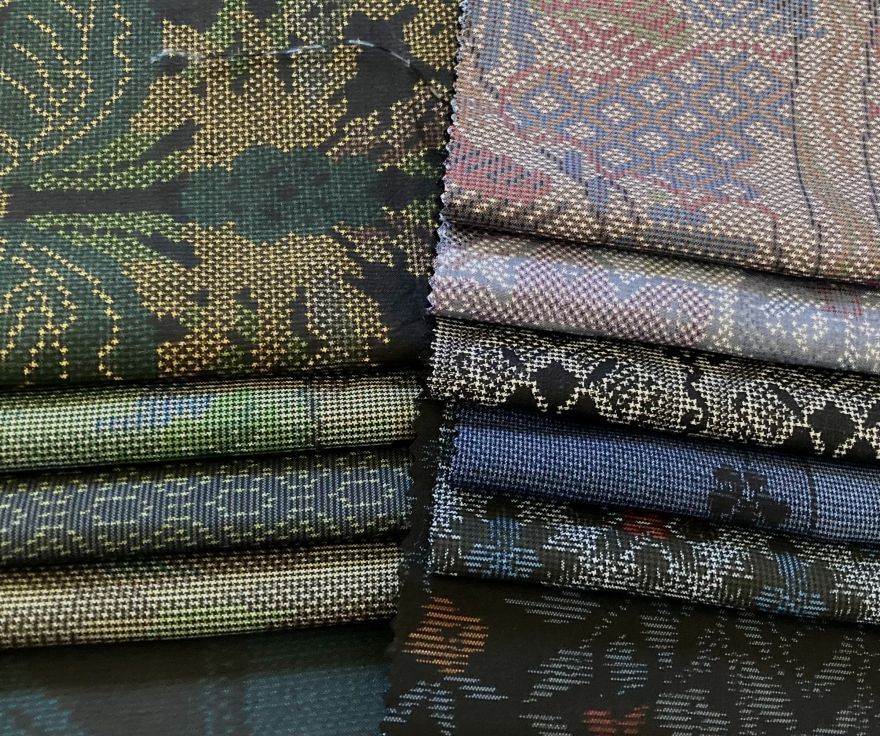
With a magnifying glass, examine how the pattern is formed. In kasuri, an ikat-style technique, yarns are patterned before weaving, and the design emerges from the alignment of colored threads. At close range, the pattern follows the threads rather than sitting only on the fabric surface.
A printed design may be concentrated on the face, although some printing methods also penetrate the reverse. This check helps distinguish construction methods, but it cannot, by itself, prove that a garment is silk or authentic Oshima tsumugi.
Ask online sellers for photos that answer specific questions
If you can’t handle the kimono yourself, request photographs in indirect daylight showing the front and back of the fabric, a close-up of the weave, the inner lining, and any labels, stamps, or certificates. Ask the seller to confirm whether their fiber identification is based on an original label or personal judgment.
Request measurements in both centimeters and inches, including garment length (mitake), yuki (the reach from the center back of the neck across the shoulder to the sleeve end), and width at the hips. Kimono sizing is different from ordinary US clothing sizes, and a well-preserved silk piece still needs to fit the wearer.
When documentation is missing, it’s reasonable to describe the material as “believed to be silk” rather than “verified 100% silk.” That distinction matters when buying or reselling online.
Can a Burn Test Identify Kimono Fabric?
What different fibers may do when exposed to flame
A fiber burn test examines whether a sample chars, melts, or leaves ash. Textile laboratories use burning behavior as one identification method, but also use microscopy, solubility tests, and infrared spectroscopy where appropriate. Burning alone is not a reliable way to certify a valuable kimono’s exact composition.
| Fiber | Typical reaction | Typical odor and residue |
|---|---|---|
| Silk | Chars and may stop burning when removed from the flame | Burned-hair odor; brittle, crushable dark residue |
| Polyester | Often shrinks and melts, sometimes burning | Plastic-like odor; hard bead after cooling |
| Wool | Chars rather than melting like polyester | Burned-hair odor; brittle dark residue, similar to silk |
| Cotton or linen | Usually burns readily without melting | Burning-paper odor; soft, fine ash |
| Rayon | Usually burns in a cellulose-like way | Paper-like odor; soft ash |
These observations are approximate. Dyes, coatings, treatments, mixed fibers, and different warp and weft yarns can change the result. In particular, silk and wool are both protein fibers and may behave similarly. A burn test cannot establish whether a kimono is “100% silk,” identify its maker, or verify its age.
Why you should not burn a thread from a valuable kimono
Removing yarn from a seam allowance can weaken old fabric, and an exposed flame can damage a garment or release irritating fumes. Never test a kimono in a store without permission, and do not use the stitching thread or a lining thread as a substitute for the outer fabric: they may be different fibers.
If a detached, expendable swatch of the outer fabric already exists and you choose to have it examined, give it to an experienced textile professional or a testing laboratory. If a trained person conducts a flame test, it should be performed on that separate sample only, away from the kimono and other flammable items, using proper ventilation, metal tools, a heat-resistant surface, and fire-extinguishing equipment. Smoke must not be inhaled directly, and residue must be fully cool before handling.
For uncertain or valuable pieces, professional fiber identification is safer and more informative than experimenting with a lighter. Japan’s Kaken Test Center describes several established approaches to fiber identification.
How to Check Oshima Tsumugi, Certificates, and Maker Marks
What a shoshi certificate can tell you
A shoshi is an important piece of documentation associated with certain Japanese fabrics and production regions. Depending on the certificate, it may identify the producer, regional association, product standard, or whether the cloth meets particular inspection requirements. Not every certificate lists the exact fiber composition, so read what it actually says.
For Honba Oshima Tsumugi, an established Japanese silk textile, the relevant production association’s certificate is especially useful. The Honba Oshima Tsumugi Weaving Cooperative explains its inspection and trademark system, including information about manufacturing methods. A missing certificate does not automatically mean a kimono is fake; paperwork is often lost after tailoring or resale.
Japan also has a Traditional Craft Mark system for qualifying products made under designated craft standards. This is different from a blanket guarantee that every old or unmarked kimono is, or is not, genuine silk.
Check rakkan signatures and other markings carefully
A rakkan (落款) is a maker’s or artist’s mark. On some dyed kimonos it appears in an unobtrusive area, such as near the front overlap panel or lower front edge. Other markings may appear on surviving fabric ends or separate certificates.
Photograph the mark clearly and compare it with reliable references for that artist or workshop. A mark is useful evidence to investigate, but its presence alone does not prove authorship, fabric content, or market value. If a seller makes a substantial price claim based on the signature, consider independent authentication.
What actually influences secondhand kimono value
Silk is not automatically more valuable than every polyester kimono. Origin, workmanship, rarity, documentation, fashion demand, garment measurements, and condition can all affect resale prices. A certified, well-preserved Oshima tsumugi may attract specialist collectors; a damaged silk kimono may be worth less than an attractive, practical synthetic piece.
Inspect collar and underarm stains, fading, loose seams, odors, and lining damage before paying a premium. Keep any shoshi, spare fabric, and provenance records with the garment. For an expensive purchase, compare multiple specialist valuations rather than relying on a generic online price range.
How to Clean and Store a Kimono When the Fabric Is Unknown
Don’t assume silk or polyester can be washed the same way
If the kimono has no trustworthy care label, avoid machine washing, soaking, or spot-treating it until the material and dye stability are understood. Water can cause shrinkage, color bleeding, spotting, or distortion in some silk and rayon fabrics. A polyester outer layer does not guarantee that the lining, stitching, or decorative finishes can tolerate washing.
After wearing, allow a sound, clean garment to air briefly in a shaded, well-ventilated space before folding it. For stains, fragile fabric, or an heirloom piece, ask a cleaner familiar with traditional Japanese garments or a textile conservator for advice. Avoid experimenting with household stain removers.
Store vintage kimonos away from light and moisture
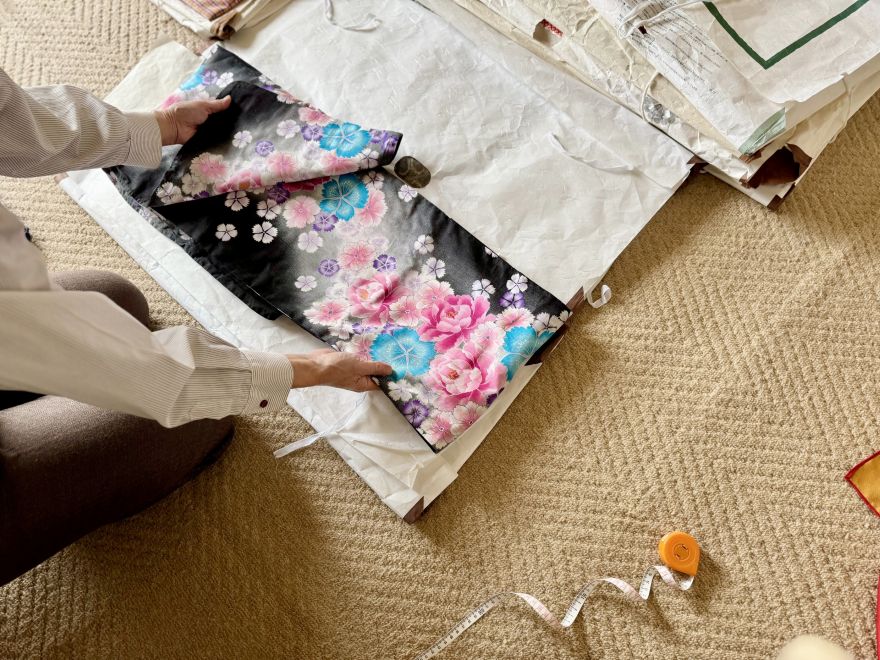
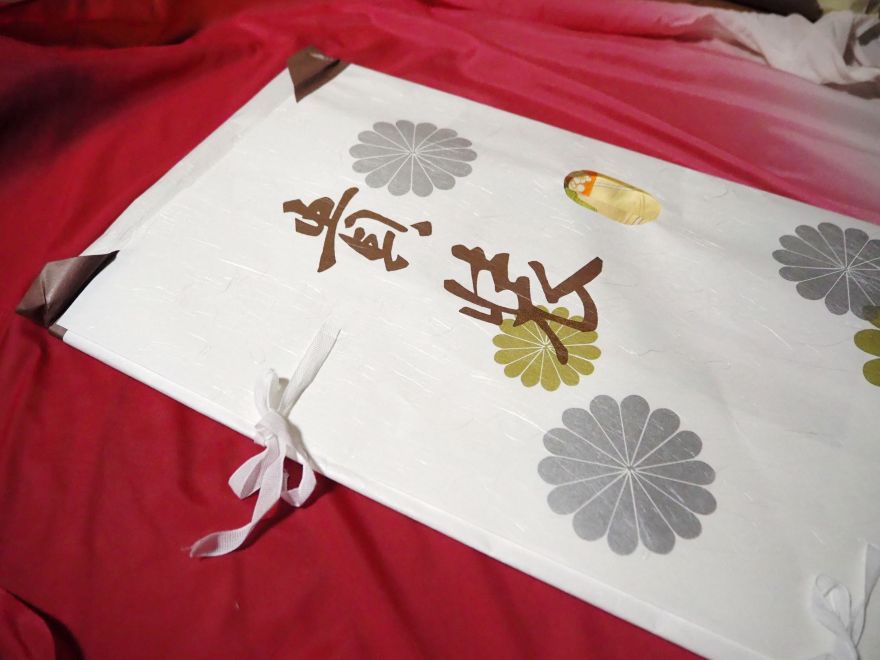
Traditional tatoushi (たとう紙) are paper wrappers used to protect folded kimonos. For longer-term preservation, the broader principles are to keep textiles clean, protected from light, and in an environment without major fluctuations in humidity or temperature.
Fold the kimono gently without crushing embellishments, and avoid tight plastic bags. For a fragile or historically important item, unbuffered acid-free tissue or clean cotton fabric can protect folds and surfaces; packaging should suit the local climate. Check stored garments periodically for moisture, mildew, insects, and changes in condition. The Smithsonian’s textile storage guidance provides practical preservation advice.
Frequently Asked Questions
Can you tell if a kimono is silk from photos alone?
Sometimes you can make an educated guess from close-up photos of the weave, drape, lining, and labels, but photographs cannot reliably prove fiber composition. Ask for documentation or a specialist assessment if certainty matters.
What does “100% silk” look like on a Japanese kimono label?
Look for 絹100% or a clearly stated silk content. The term 正絹 generally means pure silk. Confirm that the label belongs to the garment being sold.
Can a machine-sewn kimono still be real silk?
Yes. Machine stitching does not rule out silk, just as hand stitching does not guarantee it. Construction quality and fiber composition are separate questions.
Can a burn test distinguish silk from wool?
Not reliably on its own. Both are protein fibers that can char, produce a burned-hair smell, and leave brittle residue. Laboratory testing may be needed to distinguish them or identify blends.
Can I machine-wash a polyester kimono?
Only when the garment’s care instructions and construction support it. Some polyester kimonos are designed to be washable, but linings, dyes, trims, and vintage alterations can make washing unsafe. If the label is missing, seek specialist advice.