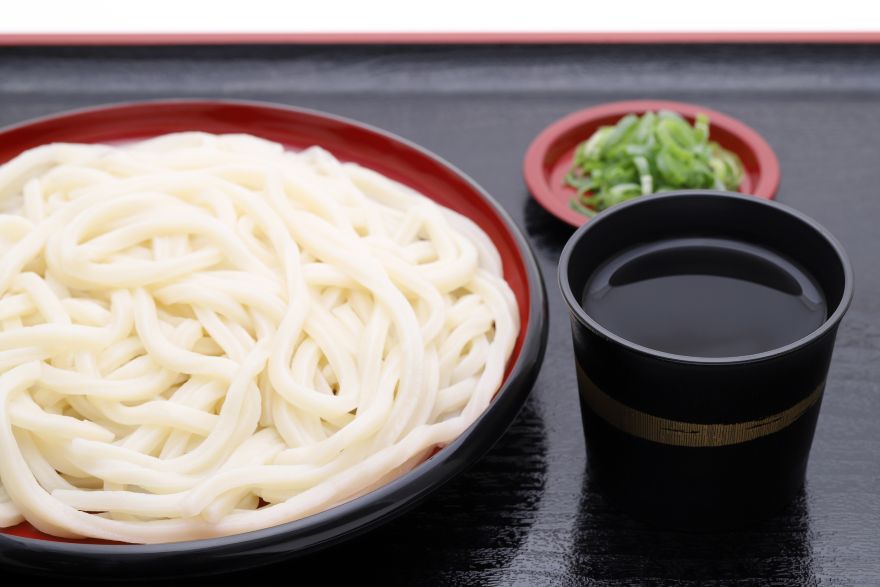
For one person, a practical udon serving size is 80–100 g (2.8–3.5 oz) of dried noodles or 120–150 g (4.2–5.3 oz) of uncooked fresh noodles. If you’re using frozen or precooked udon, one individually packaged portion is usually a convenient starting point.
The important thing is to distinguish between uncooked and cooked weights. Dried udon absorbs a considerable amount of water during boiling, while frozen and precooked noodles have generally already been cooked.
Here’s how to choose the right amount of udon for one person, compare different noodle types, estimate cooked weights, and understand the calorie differences.
Udon Serving Size Chart: How Much Per Person?
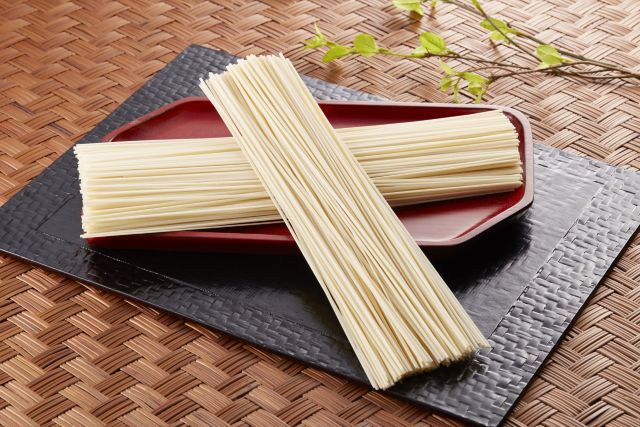
Udon is a Japanese wheat noodle available in several forms. The amount you need depends on whether the noodles are dried, fresh, frozen, or precooked.
The following serving sizes are practical starting points for a meal, not fixed rules. Always check the package if the manufacturer provides a recommended portion size.
| Type of udon | Amount per person | Weight when ready to eat |
|---|---|---|
| Dried udon | 80–100 g (2.8–3.5 oz), uncooked | About 190–240 g (6.7–8.5 oz) |
| Fresh, uncooked udon | 120–150 g (4.2–5.3 oz) | About 216–270 g (7.6–9.5 oz) |
| Semi-dried udon | Follow the package’s serving size | Varies by product |
| Frozen udon | One portion; 180 g (6.3 oz) is one product example | Generally close to the packaged weight |
| Precooked udon | One package; 200 g (7.1 oz) is one product example | Generally close to the packaged weight |
The cooked-weight estimates for dried and fresh udon use the reference weight-change rates published by Japan’s Ministry of Education, Culture, Sports, Science and Technology (MEXT). Individual products and cooking methods may produce different results.
Dried Udon: 80–100 g Per Person
Dried udon noodles contain relatively little moisture, making them easy to store. Because they absorb water during cooking, you should measure your portion before boiling.
For most home meals, 80–100 g (2.8–3.5 oz) of dried udon per person is a useful starting point.
- Light portion: 60–80 g (2.1–2.8 oz)
- Regular portion: 80–100 g (2.8–3.5 oz)
- Larger portion: More than 100 g (3.5 oz), adjusted to your appetite
Using MEXT’s reference conversion rate, 100 g of dried udon produces approximately 240 g (8.5 oz) of cooked noodles.
Some dried udon brands sell noodles in bundles, making portioning easier. If your package has a recommended serving size, use that as your first reference.
For an alternative cooking method, see our guide to cooking dried udon noodles in the microwave.
Fresh Udon: 120–150 g Before Cooking
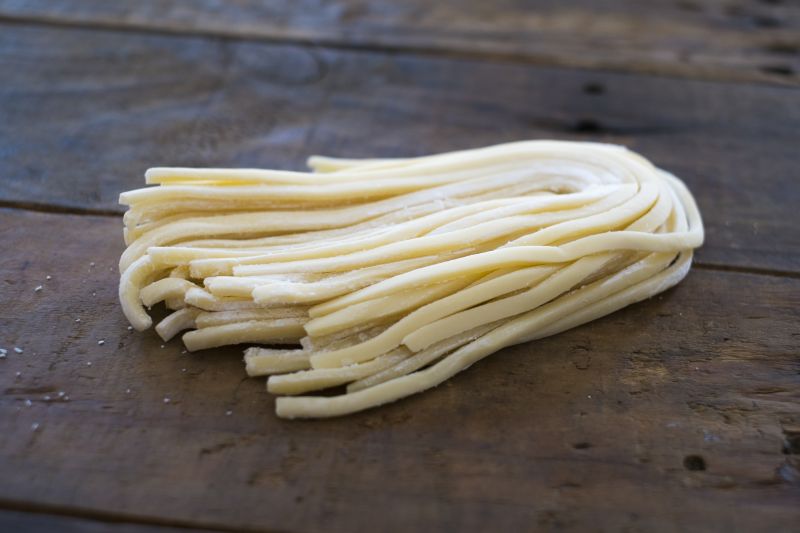
Fresh, uncooked udon contains more moisture than dried noodles. For a homemade meal, 120–150 g (4.2–5.3 oz) per person is a reasonable starting point.
According to MEXT’s reference weight-change rate of 180%, 120 g of uncooked fresh udon becomes approximately 216 g after boiling, while 150 g becomes approximately 270 g.
Be careful with the word “fresh” on packaging outside Japan. Some products marketed as fresh udon are actually precooked noodles sold in refrigerated or vacuum-sealed packages.
If the noodles are already cooked and only need reheating, treat them as precooked udon rather than applying the weight estimates for raw fresh noodles.
Frozen Udon: Check the Weight of Each Portion
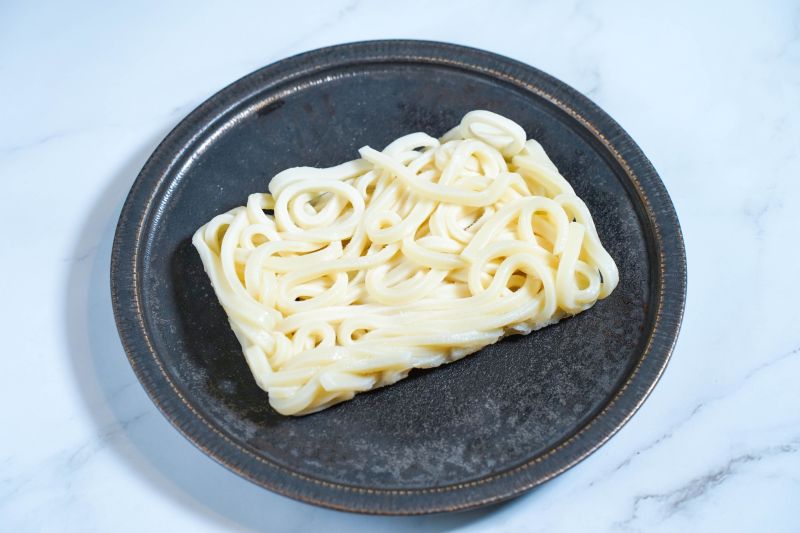
Frozen udon is popular in Japan, especially varieties such as Sanuki udon, known for its firm, chewy texture.
Many frozen udon products are cooked before freezing. They usually need reheating rather than the lengthy boiling required for dried noodles.
For example, Japanese manufacturer TableMark sells a five-serving package of Katokichi Sanuki Udon containing 900 g (31.7 oz) in total. Each portion weighs 180 g (6.3 oz).
Source: TableMark’s official frozen udon product information.
This does not mean every frozen udon block weighs 180 g. Products sold outside Japan may have larger or smaller portions.
When buying frozen udon, check the net weight, number of servings, and cooking instructions. Follow the manufacturer’s directions for microwave heating or boiling rather than assuming every product can be thawed the same way.
Precooked Udon: One Package Is Often One Serving
Precooked udon is sometimes labeled “cooked udon,” “ready-to-cook udon,” or “vacuum-packed udon” in English-speaking markets.
These noodles have already been boiled or otherwise cooked and usually need only reheating before serving.
In Japan, some refrigerated udon products are sold in 200 g (7.1 oz) packages. For example, Aimen’s Yude Teuchishiki Udon contains 200 g per package, which the manufacturer identifies as one serving.
Source: Aimen’s official product information.
For these products, the packaged weight is generally a more useful serving guide than the uncooked weight recommendations for dried noodles.
However, not all precooked udon packages contain exactly 200 g. Always read the label before deciding how many packages to prepare.
Semi-Dried Udon: Follow the Package
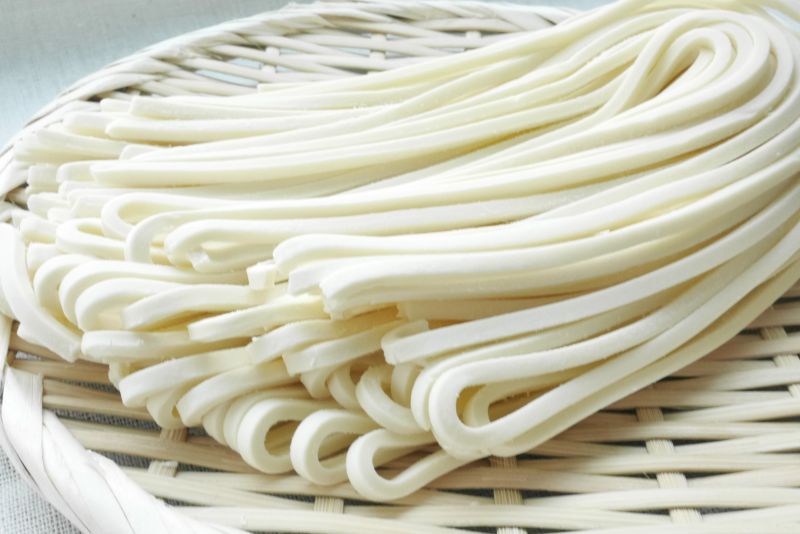
Semi-dried udon falls between fresh and fully dried noodles in moisture content.
Because moisture levels and production methods vary, there is no single serving weight that works for every semi-dried product.
Check the package for its net weight, recommended number of servings, and boiling time. Do not automatically use the same cooked-weight conversion rate as fresh or dried udon.
How Much Does Udon Weigh After Cooking?
Udon becomes heavier during boiling mainly because the noodles absorb water. The amount of weight gained depends on their initial moisture content and cooking method.
Japan’s official food composition reference uses approximate weight-change rates of 240% for dried udon and 180% for uncooked fresh udon.
| Noodle type | Weight before boiling | Estimated cooked weight |
|---|---|---|
| Dried udon | 80 g (2.8 oz) | 192 g (6.8 oz) |
| Dried udon | 100 g (3.5 oz) | 240 g (8.5 oz) |
| Fresh, uncooked udon | 120 g (4.2 oz) | 216 g (7.6 oz) |
| Fresh, uncooked udon | 150 g (5.3 oz) | 270 g (9.5 oz) |
You can estimate the cooked weight using these simple calculations:
- Dried udon: Uncooked weight × 2.4
- Fresh, uncooked udon: Uncooked weight × 1.8
For example, if you cook 200 g (7.1 oz) of dried udon, the estimated cooked weight is 480 g (16.9 oz).
These are reference calculations, not guaranteed results. Noodle thickness, cooking time, and draining can all affect the final weight.
Source: MEXT, Standard Tables of Food Composition in Japan (Eighth Revised Edition), Updated and Enlarged Version 2023, cooking weight-change data.
Udon Calories: Dry vs. Fresh vs. Cooked Noodles
When comparing udon calories, it’s important to check whether the nutritional values refer to uncooked or cooked noodles.
Dried noodles contain much less water than boiled noodles, so their calories per 100 g are generally higher. Cooking changes the water content and can also affect the nutrients retained in the noodles.
The following figures come from Japan’s Standard Tables of Food Composition, using the 2023 updated and enlarged edition.
| Type of udon | Calories per 100 g | Condition |
|---|---|---|
| Dried udon | 333 kcal | Uncooked |
| Boiled dried udon | 117 kcal | After boiling |
| Fresh udon | 249 kcal | Uncooked |
| Boiled udon | 95 kcal | After boiling |
Official food composition data: dried udon, boiled dried udon, fresh uncooked udon, and boiled udon.
These values represent different food categories and preparation states. They should not be treated as interchangeable.
For example, 100 g of dried udon and 100 g of boiled udon do not represent the same original amount of noodles.
Frozen udon can also have different nutritional values from the general boiled-udon reference. TableMark’s Katokichi Sanuki Udon, for example, lists 247 kcal per 180 g serving.
For packaged noodles, use the nutritional label on the specific product whenever possible. If you’re calculating the calories of an entire udon meal, remember to include the broth, sauce, and toppings.
Tempura, meat, eggs, tofu, and other additions can change the calorie content of the finished dish.
How to Adjust Udon Portions for Your Meal
There is no universally correct amount of udon for every person. The right serving size depends on appetite, age, and what else you’re serving.
- For a lighter meal: Start with 60–80 g (2.1–2.8 oz) of dried udon, or choose a smaller portion of precooked noodles.
- For a regular meal: Try 80–100 g (2.8–3.5 oz) of dried udon, 120–150 g (4.2–5.3 oz) of uncooked fresh udon, or one packaged serving of frozen or precooked noodles.
- For a more substantial meal: Increase the noodles slightly or add toppings such as eggs, meat, tofu, mushrooms, or vegetables.
If you’re serving udon alongside tempura, rice, or other side dishes, you may prefer a smaller noodle portion.
If udon is the main component of your meal, a larger portion may be more satisfying.
For children, start with a smaller amount appropriate for their age and appetite rather than automatically serving a full adult portion.
One common mistake is comparing 100 g of dried noodles directly with 100 g of precooked noodles. Because the moisture content is very different, those quantities will not produce similar-sized meals.
How to Cook and Serve Different Types of Udon
Udon preparation varies by type. Dried and uncooked fresh udon need boiling, while many frozen and precooked products are designed for relatively quick reheating.
Cooking Dried and Fresh Udon
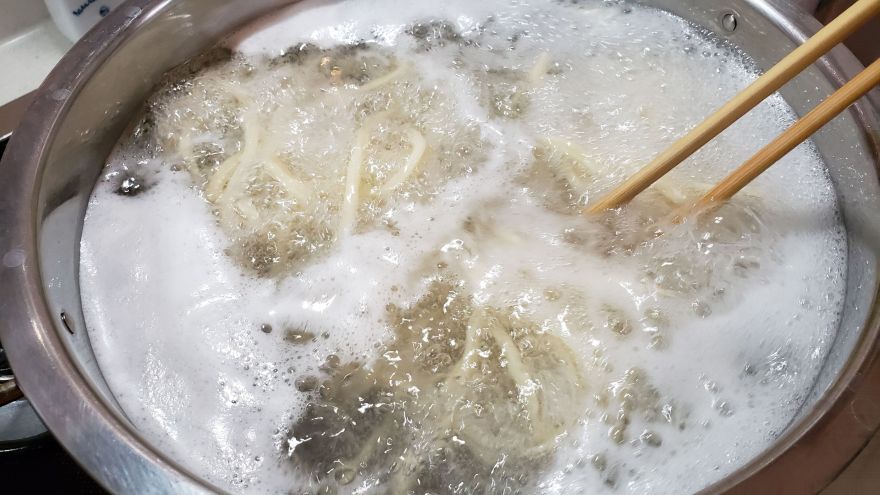
For dried or uncooked fresh udon, the simplest approach is to follow the instructions printed on the package.
- Bring the recommended amount of water to a boil in a sufficiently large pot.
- Add the noodles and gently stir to separate them.
- Boil for the recommended time, adjusting the heat if the water starts to foam over.
- Check that the noodles are cooked to your preferred texture.
- For cold udon, rinse and chill the noodles as directed, then drain thoroughly.
- For hot udon, drain the noodles and combine them with prepared broth or sauce.
Cooking times vary significantly between thin dried udon, thick fresh noodles, and other varieties. Do not assume they all require the same boiling time.
Frozen and precooked udon generally need less cooking. Follow the package instructions, particularly when using a microwave.
How Much Broth or Dipping Sauce Per Serving?
The amount of broth or sauce depends on how you’re serving your udon.
In Japan, two familiar serving styles are kake udon, where noodles are served in hot broth, and zaru udon, where chilled noodles are dipped into a separate sauce.
- Hot udon soup: Start with approximately 250–300 mL (about 1–1¼ US cups) of prepared broth per person.
- Cold udon with dipping sauce: Start with approximately 100–150 mL (about 3½–5 US fl oz) of prepared dipping sauce per person.
These are practical home-serving estimates. Adjust them to your bowl size and personal preference.
If you’re using bottled mentsuyu, a Japanese noodle soup base commonly made with dashi, soy sauce, and seasonings, check the dilution instructions carefully.
Concentrated mentsuyu is typically diluted differently for hot noodle soup and cold dipping sauce. The amounts above refer to prepared broth or sauce, not undiluted concentrate.
If mentsuyu is unavailable, you can prepare a simple Japanese-style noodle broth using dashi and appropriate seasonings.
Is a Serving of Udon the Same as Soba?
Udon and soba are both popular Japanese noodles, but they are made from different ingredients. Traditional udon is wheat-based, while soba is made with buckwheat flour, sometimes combined with wheat flour.
For dried noodles, some brands of both udon and soba recommend approximately 80–100 g (2.8–3.5 oz) per person.
However, that doesn’t mean the recommended portions are identical for every product.
Noodle thickness, ingredients, packaging, and intended serving style can vary. If you’re replacing dried soba with dried udon in a recipe, begin with the manufacturer’s serving recommendation and adjust to your appetite.
Are Restaurant Udon Portions Standardized in Japan?
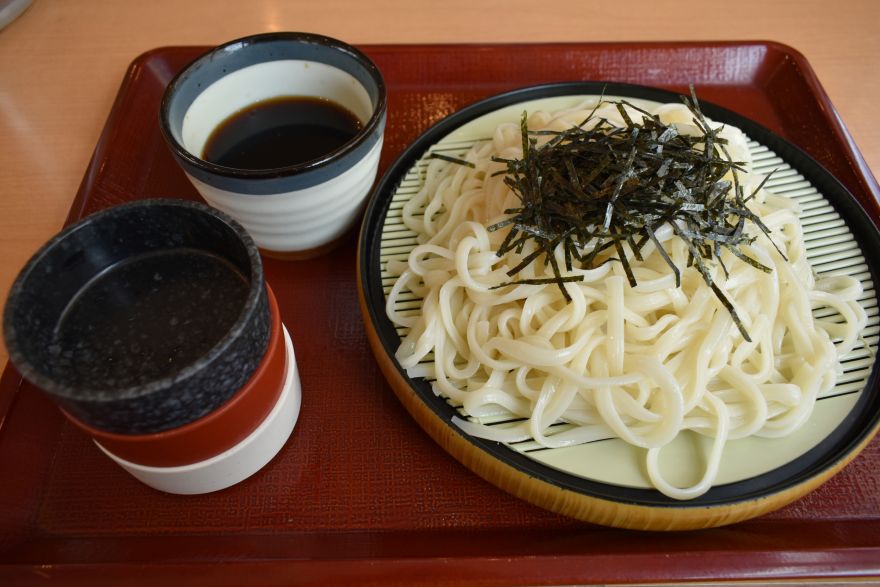
Not necessarily. Japanese udon restaurants commonly offer different portion sizes, but a restaurant’s regular serving should not automatically be assumed to contain the same amount of noodles as a 200 g supermarket package.
For example, the Japanese udon chain Marugame Seimen offers different serving-size options depending on the menu. However, a single verified noodle weight in grams should not be assumed for every menu item and location.
If the precise quantity matters, check the restaurant’s current menu or ask the staff. You can also refer to Marugame Seimen’s official Japanese menu.
Frequently Asked Questions
How much does 100 g of dried udon weigh after cooking?
Approximately 240 g (8.5 oz), using Japan’s official reference weight-change rate of 240%. The actual weight depends on the noodles and cooking method.
How much dried udon do I need for 200–250 g of cooked noodles?
Using the approximate 2.4-times weight increase, you need around 85–105 g (3.0–3.7 oz) of dried udon. Starting with 80–100 g is usually convenient.
Is one 180 g block of frozen udon the same as 100 g of dried udon?
No. A 180 g frozen block generally weighs close to 180 g when ready to eat, while 100 g of dried udon can become approximately 240 g after boiling. Their calories and texture may also differ.
Is 200 g of udon one serving?
It can be. Some precooked udon packages contain 200 g and are labeled as one serving. But 200 g of dried udon would generally provide about two to two-and-a-half regular portions based on an 80–100 g dried-noodle serving.
How much udon should I cook for two people?
As a starting point, prepare 160–200 g (5.6–7.1 oz) of dried udon or 240–300 g (8.5–10.6 oz) of uncooked fresh udon. For frozen or precooked noodles, use two individually packaged servings if the label identifies each as one portion.
Do frozen and precooked udon have the same calories?
Not necessarily. Their ingredients, moisture content, and production methods can differ. Compare the nutritional labels using the same serving weight or per-100-g basis rather than assuming they have identical calories.